
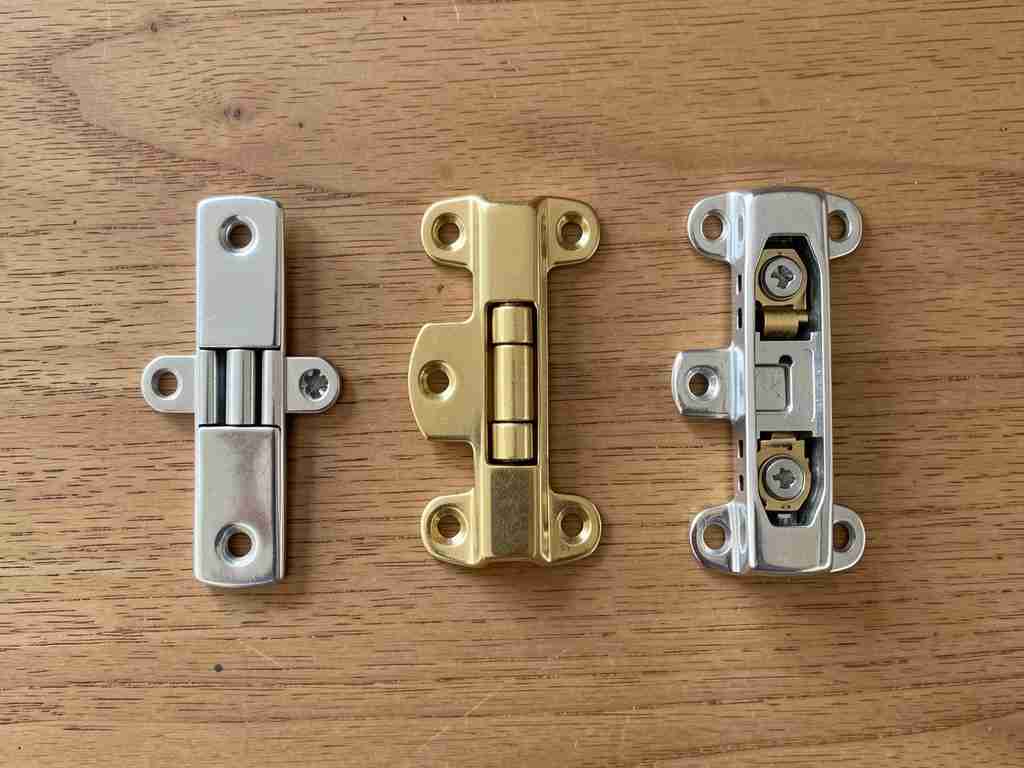
When you start a kitchen or bathroom renovation, choosing the right cabinet hinge can feel like a small detail. But this decision affects how your doors open, close, and hold up over years of daily use. This guide covers the full range of hinge types, measurements, installation factors, and material choices you need to make.
Tip: Always buy one extra hinge per cabinet door size. If a hinge gets damaged during installation, you save a trip to the store and avoid mismatched hardware.
Quick Verdict: Simply put, choosing the right cabinet hinge means matching your door overlay style, door weight, and desired motion. Overlay type determines the hinge style. Door weight determines the hinge grade. Motion preference determines the closing mechanism. These three factors guide every correct hinge decision.
Key Takeaways
- Choosing the right cabinet hinge starts with identifying your cabinet door’s overlay type: full overlay, half overlay, or inset.
- The hinge you select must support the door weight and size. A door over 30 inches tall or 10 pounds needs a heavy-duty hinge with stronger mounting plates.
- Soft-closing hinges reduce door slamming and extend cabinet life. They cost more upfront but prevent wear on cabinet frames over time.
- European concealed hinges offer the cleanest look and greatest adjustability. They dominate modern cabinet design these days.
- Surface mount hinges and self-closing hinges work best for traditional cabinetry and budget-sensitive projects.
What Is a Cabinet Hinge and Why Does It Matter?
A cabinet hinge is the mechanical joint that connects a cabinet door to the cabinet frame. It allows the door to swing open and closed while supporting the door’s weight. Hinges come in dozens of variations based on mounting style, closing mechanism, and material.
The hinge you pick directly affects how the door aligns with surrounding cabinets. A wrong hinge can cause gaps, rubbing, or doors that do not close flush. According to the National Kitchen and Bath Association, incorrect hinge selection causes about 30 percent of all cabinet installation callbacks.
- A full overlay hinge fits doors that cover the cabinet frame completely.
- A half overlay hinge fits doors that share a frame between two adjoining cabinets.
- An inset hinge fits doors that sit flush inside the cabinet frame opening.
Important: Overlay measurement is the single most critical number you need. Measure from the edge of the door to the edge of the cabinet frame. If this is wrong, no hinge adjustment can fix it.
The Three Overlay Styles That Determine Your Hinge
Overlay describes how much the cabinet door covers the cabinet frame. Every hinge is designed for a specific overlay range. Getting this wrong means the door will not fit the opening.
Full Overlay Hinges
Full overlay hinges mount on the side of the cabinet frame. The door completely covers the frame. You see only a small gap between doors on adjacent cabinets. This is the standard style for European and modern kitchens. Overlay is typically 5/8 inch to 1 inch.
According to cabinet hardware manufacturers, full overlay hinges account for roughly 60 percent of all residential cabinet hinge sales. This style gives the cleanest appearance with minimal visible frame.
Half Overlay Hinges
Half overlay hinges work when two doors share a single cabinet frame divider. Each door covers half of the frame. The gap between the doors is smaller than with full overlay. Overlay is typically 5/16 inch to 1/2 inch per door.
Half overlay is common in middle cabinets where doors open from both sides. It is less popular in modern design but still necessary for many standard cabinet layouts.
Inset Hinges
Inset hinges mount inside the cabinet frame. The door sits flush with the frame surface. There is no overlay. This gives a furniture-like look that is common in traditional or craftsman style kitchens.
Inset doors require precise hinge alignment. A small mistake leaves visible gaps. According to the Cabinet Makers Association, inset hinges take 20 to 30 percent longer to install than overlay hinges.
| Overlay Type | Common Overlay Range | Best For | Installation Difficulty |
|---|---|---|---|
| Full Overlay | 5/8 to 1 inch | Modern, European kitchens | Easy |
| Half Overlay | 5/16 to 1/2 inch | Shared frame cabinets | Easy |
| Inset | No overlay (flush) | Traditional, craftsman style | Moderate to Hard |
Types of Cabinet Hinges You Need to Know
Beyond overlay, hinges differ by mounting method and closing action. Here are the main categories.
Concealed Hinges (European Hinges)
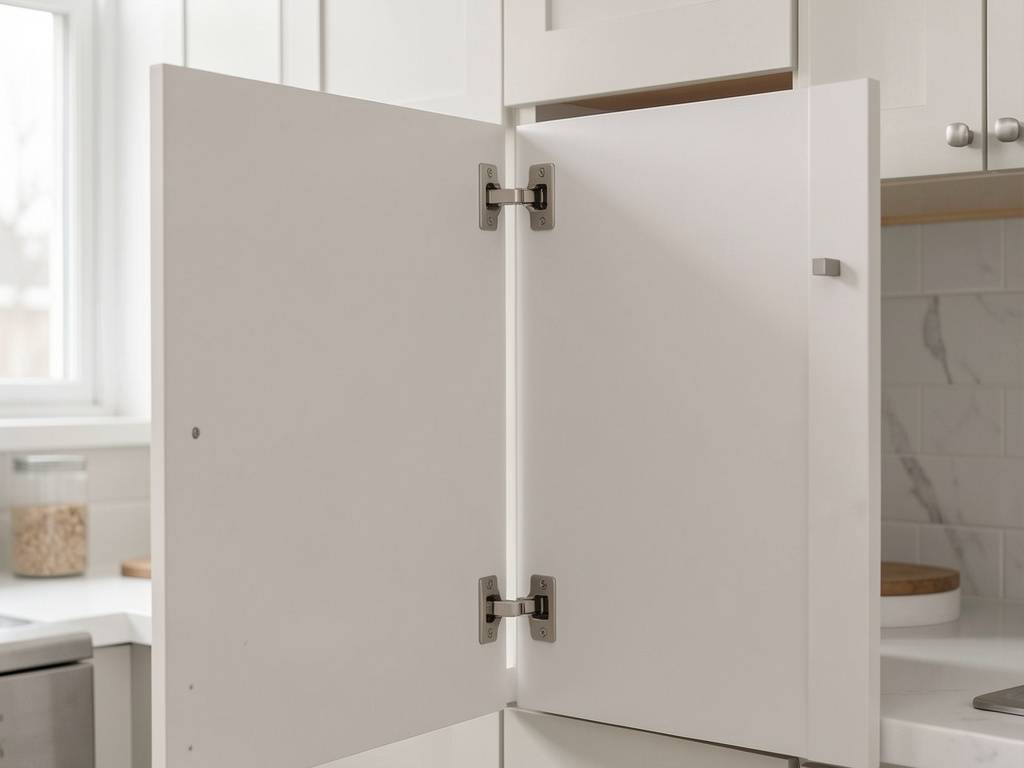
Concealed hinges attach to the inside of the cabinet. You cannot see the hinge when the door is closed. They are the most popular hinge style for new cabinets. They offer adjustment in three directions — up and down, left and right, and in and out.
These hinges use a cup that inserts into a 35mm hole on the door. The mounting plate attaches to the cabinet frame. According to the Hardware Manufacturers Association, concealed hinges now account for more than 70 percent of all new residential cabinet installations.
- Advantages: Clean look, tool-free adjustment, integrated soft-close options.
- Disadvantages: Requires drilling a cup hole, cannot install on very thin doors.
Surface Mount Hinges (Semi-Concealed)
Surface mount hinges have two visible leaves. One leaf screws to the door. The other screws to the cabinet frame. You see the hinge barrel between the door and frame when closed.
These are common on traditional and farmhouse-style cabinets. They come in self-closing and standard versions. Surface mount hinges are easier to install than concealed hinges because they require no drilling. The hardware is fully accessible for cleaning and adjustment.
- Advantages: Simple installation, works with thin doors, vintage aesthetic.
- Disadvantages: Visible hardware, less adjustability, collects dust.
Self-Closing Hinges
Self-closing hinges use a spring mechanism to pull the door shut after you release it. The door closes fully without any extra push. These are standard on many lower-cost cabinets.
Self-closing hinges can be either surface mount or concealed. The spring tension varies between models. Too much tension causes the door to slam. Too little tension leaves the door partially open. Many modern self-closing hinges let you adjust the spring strength.
Soft-Close Hinges
Soft-close hinges use a hydraulic or pneumatic damper to slow the door at the last 15 to 20 degrees of closing. The door closes gently without any noise. These hinges prevent fingers from getting pinched and reduce wear on cabinet frames.
Soft-close mechanisms are now available as integrated features on many concealed hinges. You can also buy separate soft-close adapters that attach to existing hinges. According to a recent survey by the Research Institute for Kitchen Design, over 80 percent of new upper-end kitchen builds include soft-close hinges on all doors.
Pivot Hinges
Pivot hinges allow the door to rotate on a single pin at the top and bottom of the cabinet. They are rare in standard cabinetry. They work well for tall specialty doors, such as pantry doors or bar cabinets.
Pivot hinges distribute door weight differently than standard hinges. They are harder to adjust and require precise alignment during installation.
How to Measure Your Cabinet Door Correctly
Getting the right hinge starts with accurate measurements. Here is the step-by-step process.
- Measure the door height and width in inches. Write these numbers down.
- Measure the overlay. With the door closed, measure from the edge of the door to the edge of the cabinet frame. Repeat on all four sides.
- Measure the door thickness. Standard door thickness is 3/4 inch. Budget doors can be 5/8 inch. Custom doors can be 7/8 inch or 1 inch.
- Measure the frame thickness. The hinge mounting plate needs enough frame surface to screw into. If the frame is less than 3/4 inch wide, you need a special hinge.
- Weigh the door. Remove the door and place it on a scale. If it is over 10 pounds, use a heavy-duty hinge.
Warning: Never guess the overlay measurement. Even a 1/16 inch error makes the door misalign. Use a ruler or caliper, not a tape measure, for accuracy.
Choosing the Right Cabinet Hinge for Door Weight
Door weight directly determines the hinge strength you need. A typical cabinet door made from 3/4 inch MDF weighs about 4 to 6 pounds. A solid wood door weighs more. A door with glass inserts weighs less.
Standard hinges handle doors up to 10 pounds. Heavy-duty hinges handle doors up to 20 pounds. Extra-duty hinges handle doors over 20 pounds.
Most residential cabinet doors fall in the standard range. But large doors over 30 inches tall or 20 inches wide often exceed the standard limit. In these cases, choosing the right cabinet hinge means selecting a heavy-duty model.
- Standard hinge: 3 to 10 pound door weight
- Heavy-duty hinge: 10 to 20 pounds, 2 screws per hinge leaf
- Extra-duty hinge: 20 to 35 pounds, 3 screws per hinge leaf
According to hinge manufacturers Blum and Grass, using a hinge with insufficient weight capacity is the number one cause of door sagging over time. The hinge stress fractures at the mounting plate after repeated use.
How to Choose Between Soft-Close and Standard
Soft-close hinges cost about two to three times more than standard hinges. A standard concealed hinge costs roughly 1 to 3 dollars. A soft-close version costs 3 to 8 dollars per hinge.
For a typical kitchen with 30 doors, the upgrade to soft-close adds 100 to 150 dollars total. Most homeowners consider this a worthwhile investment for noise reduction.
Soft-close hinges also add mechanical complexity. They have more internal parts that can wear out. However, most manufacturers offer a 10-year warranty on soft-close mechanisms. The extra cost is usually justified for kitchens that get heavy daily use.
Standard hinges are a better choice for utility cabinets, garages, or laundry rooms. These get less frequent use, and the cost savings matter more.
Comparison of Hinge Materials and Finishes
Hinge material affects both appearance and longevity. The most common materials are steel, brass, zinc alloy, and stainless steel.
| Material | Durability | Corrosion Resistance | Typical Finish | Best Use |
|---|---|---|---|---|
| Steel | Good | Low (may rust) | Painted or plated | Dry indoor cabinets |
| Zinc Alloy | Very Good | Good | Nickel, bronze, black | Standard kitchen cabinets |
| Stainless Steel | Excellent | Excellent | Brushed or polished | Bathrooms, kitchens near sinks |
| Brass | Very Good | Excellent | Polished or antique | Traditional, vintage style |
Zinc alloy hinges are the industry standard for concealed hinges. They offer good strength at a reasonable cost. Steel is cheaper but less resistant to moisture. Stainless steel is best for bathrooms and kitchens near the sink. Brass works well for outdoor or humid environments but costs more.
Finish matters for aesthetics. The most popular finishes are satin nickel, oil-rubbed bronze, matte black, and polished chrome. Pick a finish that matches your cabinet handles and faucet hardware. Industry surveys show that satin nickel and matte black are the top two finishes for modern kitchens.
Step-by-Step Process for Installing Concealed Hinges
Installing concealed hinges requires precision. Here is the standard process.
- Mark the hinge locations on the door. Typical placement is 3 inches from the top and 3 inches from the bottom. For wide doors, add a third hinge in the center.
- Drill a 35mm diameter hole at each mark. The depth is usually 12mm for standard doors.
- Insert the hinge cup into the hole. Secure it with the included screws.
- Attach the mounting plate to the cabinet frame. Align it so the hinge arm connects correctly. Use a level to check alignment.
- Snap the hinge arm onto the mounting plate. Some hinges use a clip. Others use a set screw.
- Adjust the door position using the hinge adjustment screws. Most concealed hinges have three adjustment points.
Tip: Use a hinge boring bit with a depth stop. This prevents drilling too deep and breaking through the door surface. A standard 35mm bit with a 12mm stop works for most 3/4 inch doors.
How to Choose the Right Hinge for Your Cabinet Material
Cabinet material affects hinge selection. Particleboard and MDF hold screws differently than plywood or solid wood.
Particleboard is the weakest material for hinge mounting. Screws strip out easily. Use hinges with larger mounting plates that distribute weight across more surface area. Some manufacturers offer particleboard-specific hinge plates with wider screw patterns.
Plywood and solid wood are strong. Standard hinge plates work fine. But you still need to pre-drill pilot holes to prevent the wood from splitting. Use a 1/16 inch drill bit for pilot holes.
MDF is dense and holds screws moderately well. However, MDF has no grain, so screws can spin out over time if the hinge is overtightened. Turn screws snug but not tight.
For thin doors under 3/4 inch, concealed hinges may not work. The 12mm cup depth would go through the door. In this case, surface mount hinges are the better choice.
Common Myths vs Facts About Cabinet Hinges
Myth: All concealed hinges are the same.
Fact: Concealed hinges vary widely in quality, weight capacity, and adjustability. A cheap hinge may have limited adjustment range and less corrosion resistance. According to industry testing, premium hinges from Blum or Grass last 50 percent longer than budget brands.
Myth: Soft-close hinges break more often.
Fact: Soft-close hinges are more complex, but modern designs are very reliable. Most failures come from overtightening screws or installing on undersized doors. The failure rate for soft-close hinges is below 1 percent according to major hardware manufacturers.
Myth: You can mix hinge types in the same cabinet run.
Fact: Mixing hinge types is not recommended. Different hinges have different overlay specifications and mounting plate sizes. This causes visible alignment differences between doors. Stick with one brand and one model for all doors in a single cabinet run.
Pro Tips for a Professional Hinge Installation
- Use a hinge template for consistent cup hole placement. A plastic jig costs 10 to 20 dollars and saves hours of measuring.
- Pre-drill all screw holes. This prevents wood splitting and makes screw driving easier.
- Install the same hinge model on every door in the same room. Different models have different adjustment ranges, making alignment harder.
- Leave the hinge adjustment screws slightly loose during alignment. Tighten them only after the door is perfectly positioned.
- For oversized doors over 36 inches tall, use three hinges instead of two. The third hinge goes exactly in the center between the top and bottom hinges.
- Buy a handful of extra mounting plates. Plates are the most commonly lost or damaged hinge part during installation.
Frequently Asked Questions
How do I measure the overlay for my cabinet door?
Close the door fully. Measure from the outer edge of the door to the outer edge of the cabinet frame. This distance is the overlay. Do this for each side of the door because overlay can vary between top, bottom, and sides.
Can I use a full overlay hinge on an inset door?
No. Full overlay hinges are designed for doors that cover the frame. Using them on an inset door causes the door to stick out past the frame. Inset doors require specific inset hinges that mount flush inside the frame opening.
How many hinges do I need per door?
For doors under 30 inches tall, use two hinges. For doors 30 to 48 inches tall, use three hinges. For doors over 48 inches tall, use four hinges. This rule applies to both concealed and surface mount hinges.
What is the difference between a self-closing hinge and a soft-close hinge?
A self-closing hinge uses a spring to pull the door shut. A soft-close hinge uses a damper to slow the door in the final closing angle only. Self-closing hinges can slam. Soft-close hinges cannot. Some hinges combine both features in one unit.
Are expensive cabinet hinges worth the extra cost?
For high-use kitchens and bathrooms, yes. Premium hinges offer better adjustability, smoother motion, and longer life. According to cabinet hardware reviews, premium hinges last 15 to 20 years compared to 8 to 10 years for budget hinges. The extra 3 to 5 dollars per hinge is a small price for durability.
Final Thoughts
Choosing the right cabinet hinge comes down to three measurements: overlay, door weight, and frame compatibility. Concealed hinges give the cleanest look and best adjustability for modern cabinets. Soft-close mechanisms add convenience and prevent damage over time. Always buy matching hinges for every door in the same room to ensure consistent alignment.